Printer-friendly version
 PDF version
 Water: Protecting this scarce resource | Did you know that less than 1% of the world's water supply is suitable for personal, agricultural and industrial use? With population growth and global economic development, more people are using more water. Unfortunately, water is often wasted, polluted or managed like there's an endless supply. Water scarcity is a reality that's exacerbated by environmental factors1, including: | · Climate change resulting from rising temperatures · An increase in the number of extreme weather events such as drought · Changes in the amount of rainfall | The serious socioeconomic impact of water stress Water stress occurs when a region doesn't have enough water. When this happens, people are more susceptible to health problems, poverty, lower attendance in schools and conflict. It's estimated that women in Sub-Saharan Africa spend about 40 billion hours a year fetching water at the expense of their education2. | In Ghana, girls' school attendance has risen by up to 12% because water collection time is down 15 minutes2. | When it comes to economic growth, a shortage of safe drinking water can be very harmful to businesses and result in financial losses if they have to interrupt production or pay higher supply costs. With the number of regions without access to water expected to grow, more people will be on the move. By 2030, more than 700 million people around the world could be displaced by intense water scarcity3. |
|
|
|
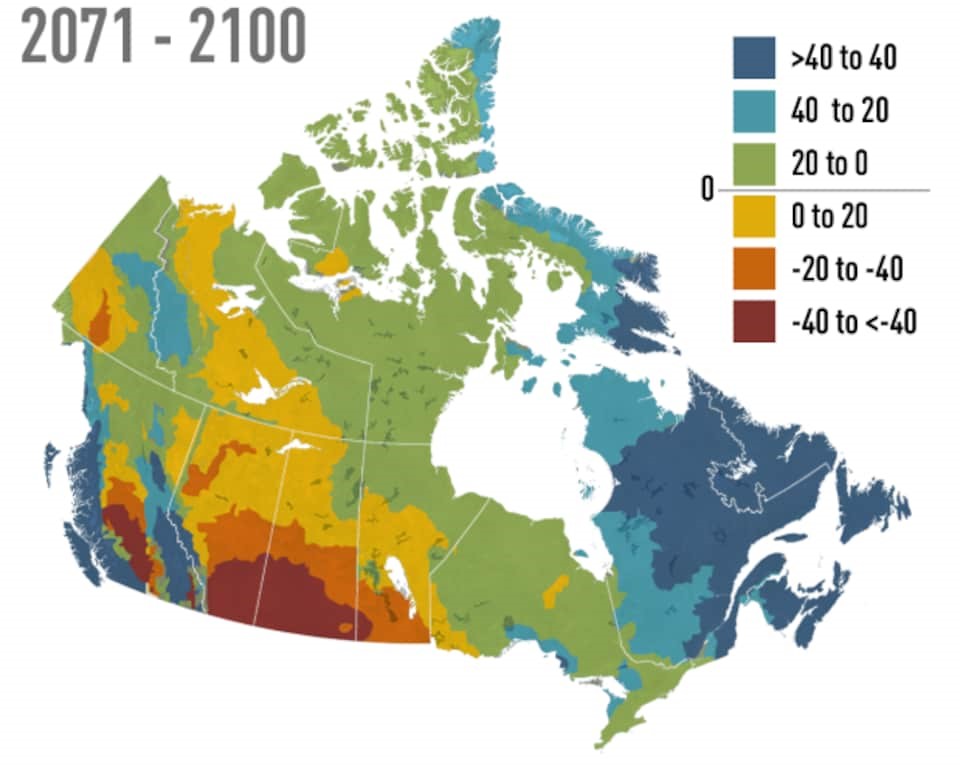
Everyone is at risk Even Canada isn't immune to water shortages. The southern Prairies, known as the country's bread basket, are very vulnerable to global warming because it could worsen the existing drought problems4. Alberta may even lose one of its main sources of water, Takakkaw Falls in Yoho National Park in the Rocky Mountains, because of melting glaciers. |
| | | The climate moisture index measures the difference between annual precipitation and the potential loss of water vapour from a landscape covered by vegetation. This projection is for the years 2071-2100 assuming the world continues to increase greenhouse gas emissions4. Source: Natural Ressources Canada |
|
|
|
Protecting water with our SocieTerra solutions Fortunately, a number of companies are concerned about water scarcity and tackling it head on. They’re committed to helping preserve and manage water in a responsible, sustainable and profitable way. The portfolio managers responsible for the Desjardins SocieTerra Funds have included many of these companies in their portfolios. In addition to their financial strength, these companies offer solutions, including: | · Process efficiency: Consuming less water per unit produced, tracking water usage more effectively and adopting products that require less water · Water infrastructure: Building and maintaining a wider network that weathers climate change to limit losses · Water treatment and sanitation: Developing filters, sterilizers and various techniques for purifying water, and building and managing treatment plants · Alternative water sources: Using seawater desalination systems, rainwater harvesting systems or water recycling. |
|
|
|
The companies the Fund invests in5 |
|
|
|
| Alternative water sources Company: Air Water Inc. Desjardins SocieTerra International Equity Fund | Air Water is a Japanese conglomerate that operates in the healthcare, industrial gases (oxygen, nitrogen and hydrogen), and agriculture sectors. |
|
|
|
The company is also involved in the fast-growing desalination sector, which transforms water from the seas and oceans into drinking water and other products, such as medical saline solutions, salt and magnesium. Furthermore, Air Water is developing absorbent treatments to remove various substances, such as arsenic, fluoride and boron from drinking water. |
|
|
|
| Water, treatment and sanitation infrastructure Company: Algonquin Power & Utilities Corp. Desjardins SocieTerra Canadian Bond Fund | Algonquin Power & Utilities is a distributor of water, natural gas and electricity that plays an active role in the energy transition. |
|
|
|
The company distributes drinking water and collects wastewater from more than 160,000 customers. In an effort to lower its water consumption, Algonquin Power & Utilities rolled out new technologies to put in place sound water efficiency, conservation, reuse and recycling practices. It also made a commitment to continue to invest in water quality improvement, water desalination projects to mitigate groundwater depletion and education to raise community awareness of the importance of water. |
|
|
|
| Process efficiency Company: Badger Meter Inc. Desjardins SocieTerra Cleantech Fund | Badger Meter is a leading manufacturer of products used to measure and control the flow of liquids for utilities companies, municipalities, and commercial and industrial clients the world over. |
|
|
|
Its solutions include smart water meters and cloud-based management software that can provide key information to help clients optimize their water usage, lower their costs and reduce waste. Badger Meter works with municipalities to help them improve their operations and be more effective and reactive. |
|
|
|
1. Desjardins Funds, 2020, 2020 Annual Report on Responsible Investment, https://www.fondsdesjardins.com/information/Annual_Report_Responsible_Investment.pdf.
2. Unesco, 2015, Gender and Water Data, http://www.unesco.org/new/fileadmin/MULTIMEDIA/HQ/SC/pdf/gender_square_ENG_v05.pdf.
3. Unicef, Water scarcity, https://www.unicef.org/wash/water-scarcity.
4. CBC News, 2018. Here are the places in Canada — yes, Canada — vulnerable to drought, Here are the places in Canada — yes, Canada — vulnerable to drought | CBC News. Image from this article.
5. The companies are in the portfolio as at May 31, 2021.